To choose a facelift surgeon abroad, check four things before you look at the price: the surgeon’s training and memberships, the hospital’s accreditation, how the surgeon performs your facelift and how often, and who looks after you after you fly home. The 12 questions below cover all four. Take them to every consultation, whether you are considering a deep plane facelift in Turkey or any other technique in any country. A good surgeon answers them calmly and in detail. If the answers are vague, that tells you what you need to know.
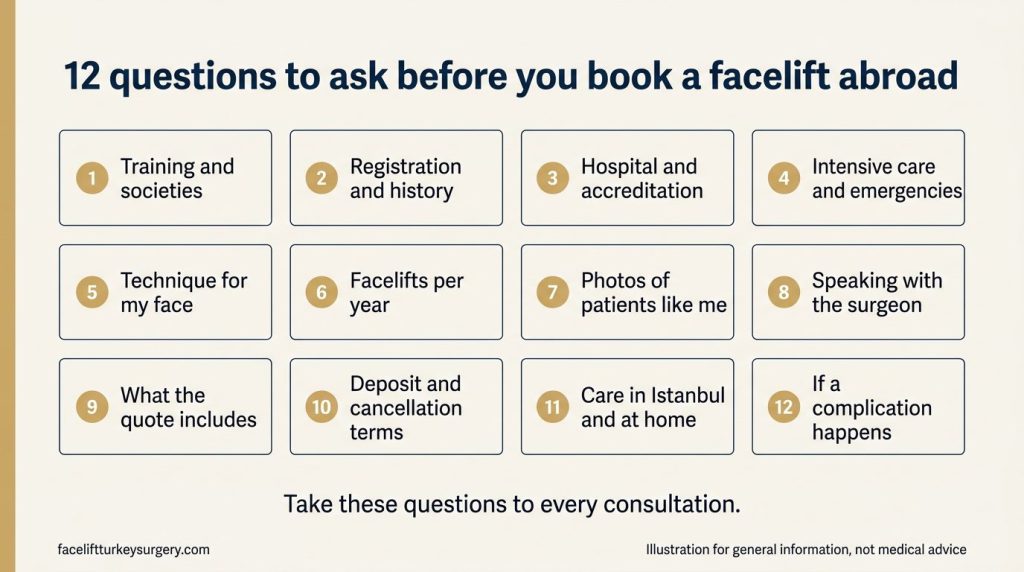
The core considerations for an overseas facelift
The most important rule is simple: surgeon skill and hospital safety come before price. Most people look abroad because a facelift costs far less than at home, and that is a fair reason. But a low price only matters if the surgeon is well trained and the hospital is safe. Decide first what you need, then compare prices between the options that meet it.
Travel is part of the plan, so think about it early. You will fly for many hours, have surgery under general anesthesia and then rest for about a week before the flight home. A typical stay is about 10 days (9 to 12 nights), and you should fly home only after your surgeon confirms you are ready. Read our travel guide for Istanbul and the step-by-step process to see what that looks like in practice.
It also helps to know who does what. Some medical travel agencies sell the trip and pass you to whichever clinic has a free slot. In our program, your surgeon plans and performs your surgery, and a patient team arranges the hotel, transfers and nurse visits around it. Whatever you choose, ask who is responsible for each part, and get it in writing. From first message to follow-up, expect about a year of contact, not just a week in another country.
Verifying credentials, disciplinary history and hospital safety
1. Is the surgeon trained in plastic surgery, and which societies is he a member of?
Look for a surgeon with formal specialist training in plastic, reconstructive and aesthetic surgery, plus membership of recognized professional societies. Be exact about the words. A membership, such as ISAPS (the International Society of Aesthetic Plastic Surgery), shows that a surgeon belongs to a professional body. A board certification, such as the European board exam in plastic surgery (EBOPRAS), is an exam a surgeon has passed. They are different things, so ask which ones apply to the surgeon you are considering, and ask to see the certificates.
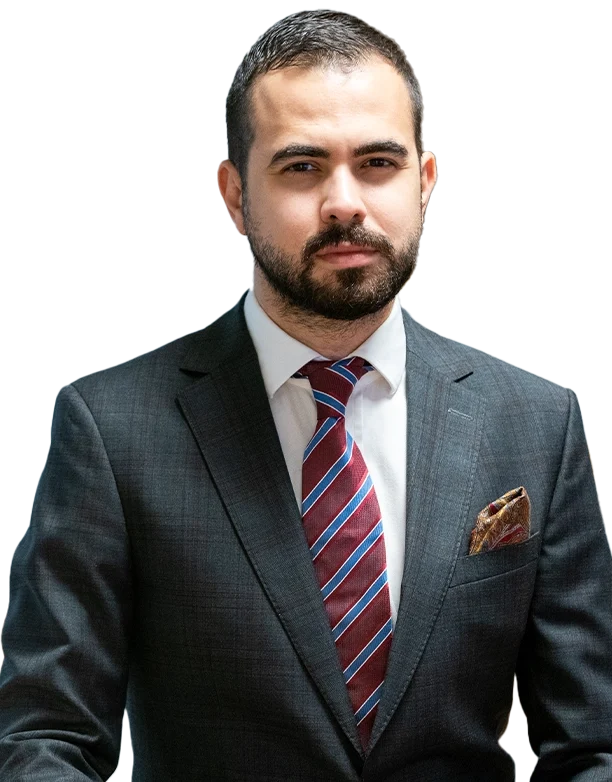
For example, Op. Dr. Fevzi Kunter Erten (“Op. Dr.” is the Turkish title for a specialist surgeon) graduated from Pamukkale University Faculty of Medicine in 2016 and completed five years of specialist training in plastic, reconstructive and aesthetic surgery at Antalya Training and Research Hospital. He gained his specialist qualification in 2022 and completed the ISAPS Fellowship Program in Istanbul the same year. He is an associate member of ISAPS and a full member of the Turkish Society of Aesthetic Plastic Surgery. His diplomas and membership certificates are on his surgeon profile.
2. Can I verify his registration and history myself?
Yes, and you should not rely on the clinic’s word alone. Ask for the surgeon’s registration number with the national medical authority of his country and check it through the official channel. Check the society’s member directory too, where one exists. Then ask directly whether the surgeon has ever faced disciplinary action or a malpractice claim. A trustworthy clinic answers this question without hesitation.
Do not rely on online reviews alone. They help, but they can be selected or even written for the clinic. Use them as one signal, next to documents you can check yourself.
3. Which hospital will I be treated in, and who accredited it?
Ask for the hospital by name, then check its accreditation with the accrediting body. Accreditation means that an outside organization audits a hospital against published standards. JCI (Joint Commission International) is a US-based accreditor of hospitals worldwide. AACI (American Accreditation Commission International) is another US-based accreditor. Accreditation does not guarantee any single result, but it shows that a hospital’s processes are inspected regularly.
We work with three accredited partner hospitals in Istanbul and select the most suitable one for each patient. Our Safety and Quality page shows how to verify each accreditation, and the hospitals page gives details.
| Hospital | Accreditation or standard | Good to know |
|---|---|---|
| Memorial Sisli Hospital | JCI accredited since 2002 | Full critical care backup, Sisli, Istanbul |
| Turkiye Hospital | AACI accredited since December 2023 | Listed by AACI as “Turkiye Gazetesi Hastanesi”, Sisli, Istanbul |
| Cakmak Hospital | Turkish Ministry of Health quality standards | Serving patients since 1994, 33 intensive care beds, Umraniye, Istanbul |
If you are searching for a JCI accredited hospital in Turkey, ask whether your surgery would actually take place in that hospital, not just a sister clinic.
4. Is there an intensive care unit and a plan for emergencies?
A hospital that performs general anesthesia surgery should have intensive care available on site, and an anesthesiologist who monitors you throughout. Facelifts are planned, low-emergency operations, but the hospital must be ready for the rare case that is not routine. Ask where you would be taken, who would be with you and how fast. For example, Memorial Sisli has full critical care backup and Cakmak Hospital has 33 intensive care beds.
Evaluating surgical expertise: techniques, experience and portfolios
5. Which technique will you use on my face, and why?
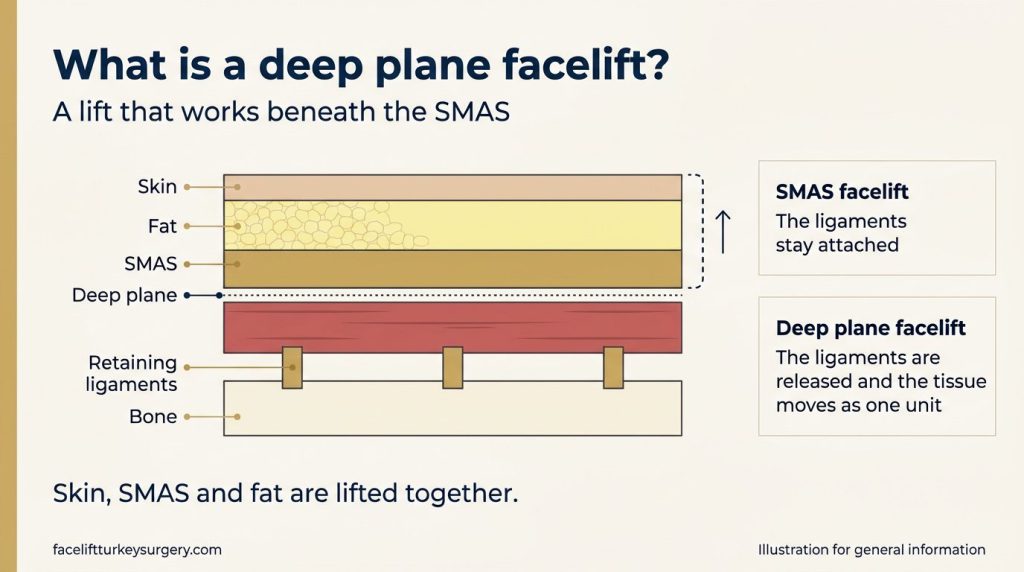
Ask the surgeon to name the technique and explain why it suits you. The two you will hear most are SMAS and deep plane. Think of the SMAS as a thin layer of strong tissue under your skin and fat, like the lining of a coat. In a SMAS facelift, the surgeon tightens or repositions that layer, so the skin does not carry the pull. A deep plane facelift works beneath that layer. The surgeon releases the ligaments that hold the cheek in place, so the skin, fat and SMAS move together as one unit.
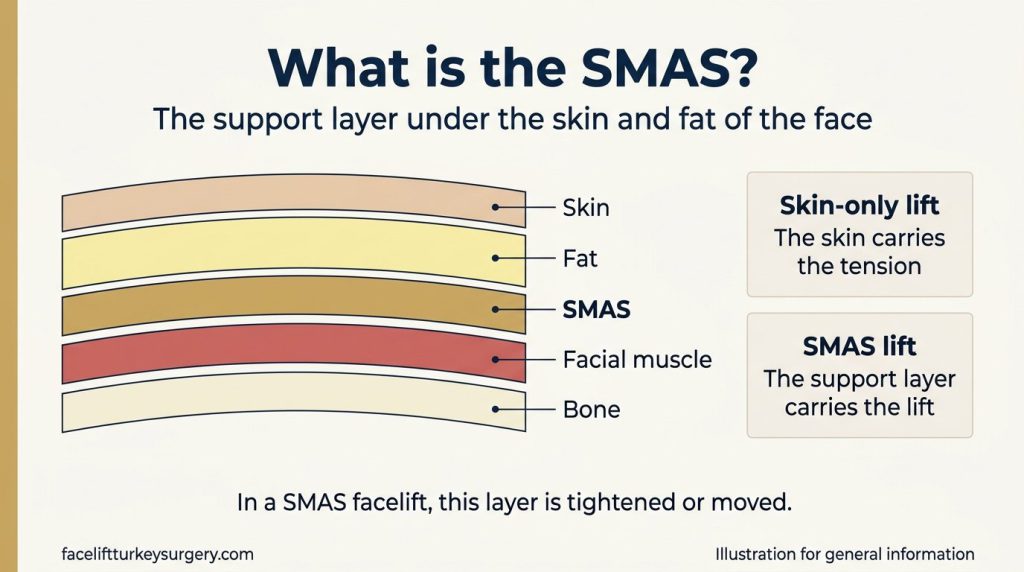
| SMAS facelift | Deep plane facelift | |
|---|---|---|
| Layer the surgeon works on | The SMAS layer, tightened or repositioned | Beneath the SMAS layer |
| Retaining ligaments | Stay attached | Released |
| What moves | The SMAS carries the lift and the skin is laid back with little tension | Skin, fat and SMAS move together as one unit |
Neither technique is right for every face. A good answer to this question is a reason based on your anatomy, not a sales pitch for one method. If a surgeon uses the same technique on everyone, ask why. Our SMAS facelift in Turkey page and our deep plane page explain each technique in detail. People who search for a deep plane facelift in Turkey should make sure the surgeon actually performs it regularly, which leads to the next question.
6. How many facelifts do you perform, and how often?
Ask for an approximate yearly number and whether facelifts are a regular part of the surgeon’s work. There is no official minimum, and a number alone proves little. But a surgeon who performs facelifts every week keeps his skills sharper than one who does a few a year among many other procedures. Also ask how many of those were the technique you are being offered. For Op. Dr. Fevzi Kunter Erten, facelift surgery is central to his daily practice.
7. Can I see before-and-after photos of patients like me?
Ask to see photos of patients with a similar face, age and plan, and learn to spot misleading ones. Fake or misleading before and after photos usually share the same problems. Use this checklist:
- The angle, distance and lighting are not the same in both photos.
- The “after” photo was taken a few days or weeks after surgery, when swelling still hides or distorts the result.
- The “after” photo is clearly filtered, softened or retouched, or the skin looks unnaturally smooth.
- The makeup, hairstyle or facial expression differs between the photos.
- There is no information about what was actually done.
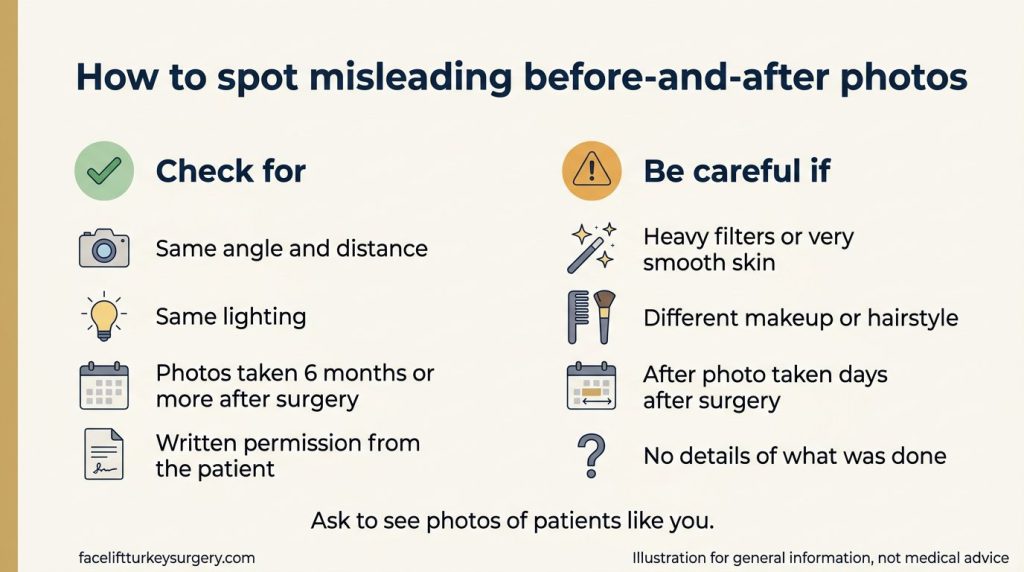
Ask for photos taken at least 6 months after surgery, and ask whether the patient gave written permission for the photos to be shared. We publish before and after photos only with the patient’s written permission, and you can see examples in the results section of our homepage.
Mastering the virtual consultation and overcoming language barriers
8. Will I speak to the surgeon himself, in a language we both speak well?
A real consultation is a video call with the surgeon, not only with a sales coordinator. Before the call, write down your medical history, your medications, any past surgery, and exactly what bothers you about your face. Send clear photos beforehand so the surgeon can prepare. The photo guide on our consultation form shows which pictures to take.

During the call, watch how he answers. Does he explain what is possible and what is not? Does he point out the areas he would treat on your face? Does he mention risks, or only benefits? A surgeon who tells you what a facelift cannot do is usually more trustworthy than one who promises everything. Op. Dr. Fevzi Kunter Erten speaks English and Turkish, so you can discuss your goals with him directly. Finally, ask how you will reach the team after surgery. The channel you use for the consultation should still work when you are recovering.
Comparing packages, avoiding hidden costs and assessing value
9. What exactly does the quote include, and what could add to it?
Ask for a written quote that lists every item, and compare quotes line by line, not by the final number. Some prices look low because they leave things out. Use this table to check each quote:
| Ask whether it is included | Why it matters |
|---|---|
| Surgeon’s fee and anesthesia | The core of the operation |
| Hospital stay and number of nights | Extra nights can add cost |
| Pre-operative tests and medication | Often listed separately |
| Hotel and airport transfers | Check the hotel level and whether transfers are private |
| Nurse visits after discharge | Who checks your healing in the hotel |
| Follow-up after you fly home | For how long, and how |
| Complication insurance | What it is and who provides it |
| Extra procedures | For example a neck lift or eyelid surgery planned with the facelift |
In our program, the package includes a 5-star hotel, private transfers, daily nurse visits, complication insurance and 12 months of follow-up. Flights are not included, and your written quote lists exactly what is covered. See the facelift cost page for typical ranges.
10. What do the contract terms say about deposits, cancellation and revisions?
Read the full terms before you pay a deposit, and keep a copy. Check how much the deposit is and whether it is refundable, what happens if you postpone, what happens if the surgeon finds a health reason not to operate, and what the clinic says about revision surgery after a complication. Do not accept verbal promises. If something matters to you, it should be in writing. Our Terms and Conditions are public, so you can read them before you contact us.
Value is also about what you are comparing. A mini facelift costs less than a combined deep plane facelift and neck lift because it treats less. Compare like with like, and do not choose the cheaper quote if it does not treat what you actually want treated.
Remote aftercare and managing complications back home
11. Who looks after me in Istanbul, and after I fly home?
Look for a clear aftercare plan with named people and regular check-ins. In our program, an English-speaking nurse visits you at your hotel every day to check your dressings and vital signs and to explain your aftercare. After you return home, you send progress photos regularly for 12 months. Your surgeon reviews your healing, and your assigned nurse reminds you of each check-in. If you have a concern, we arrange a video consultation with your surgeon.
Your own part matters too. Follow the instructions you are given: sleep with your head raised, avoid strenuous activity, avoid smoking and nicotine, and protect your skin from the sun. Healing goes best when the patient and the team work together.
12. What happens if there is a complication after I am home?
Ask for a written plan before you book. Serious complications after a facelift are uncommon, but they are real: a collection of blood under the skin (hematoma), infection or wound healing problems can happen after any surgery. Swelling that grows quickly on one side, fever, spreading redness or severe pain are reasons to call your surgeon’s team immediately and, if it is urgent, to go to a local emergency department.
Ask how the clinic handles this: who you call, how fast they answer, whether the surgeon will speak to a local doctor, and what the clinic covers. Complication insurance is included in our package, and Turkish regulation requires facilities to carry it. Ask to see what it covers in your own documents. Read our safety information for more.
Final logistical and safety checks before you book
Before you pay a deposit, go through this list:
- Ask your own doctor whether you are fit for general anesthesia and a long flight, and bring your medical records and a list of your medications.
- Check whether your travel insurance covers complications from elective surgery abroad. Many policies do not.
- Check your passport and entry rules. US citizens should read the State Department’s Turkey page and our travel guide.
- Book a return flight that can be changed. Your surgeon decides when you can fly home.
- Share your itinerary, the hospital’s name and your emergency contacts with someone you trust.
- Read every consent form in a language you fully understand before you make a final payment.
If you can answer all 12 questions with confidence, you are ready to decide. If not, keep asking. A good surgeon welcomes every one of them.
How Facelift Turkey Surgery answers these 12 questions
We wrote this guide because we want you to ask us the same questions. Here is how we answer them. Your surgeon is Op. Dr. Fevzi Kunter Erten, and you can read his training, memberships and certificates on his profile page. Your surgery takes place at one of our accredited partner hospitals in Istanbul, and we choose the one that suits your plan. You talk to your surgeon by video before you decide, and you can ask for the written plan, the written quote and the full terms before you pay anything.
Facelift Turkey Surgery is built around one surgeon and one clear program, not a menu of clinics. The program covers your 5-star hotel, private transfers, a daily nurse visit and 12 months of follow-up after you fly home. Flights are not included. If you want to see how the pieces fit, read how it works and our safety standards.
Facelift results from our patients
Remember the checklist for judging photos? Here are two real examples from our patients, so you can apply it yourself. Both patients gave written permission to show their photos. Look at the angle, the lighting and the time between the photos, and note that patients take their own after photos at home, so the conditions are not always identical. That is exactly why we encourage you to ask for more photos, from different angles and at different times, during your consultation.
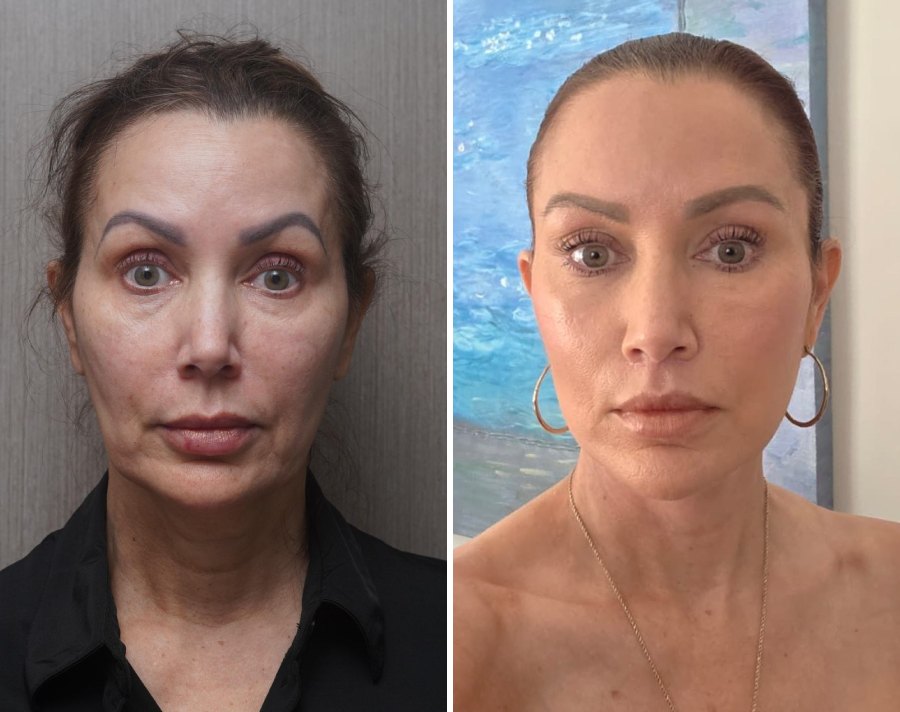
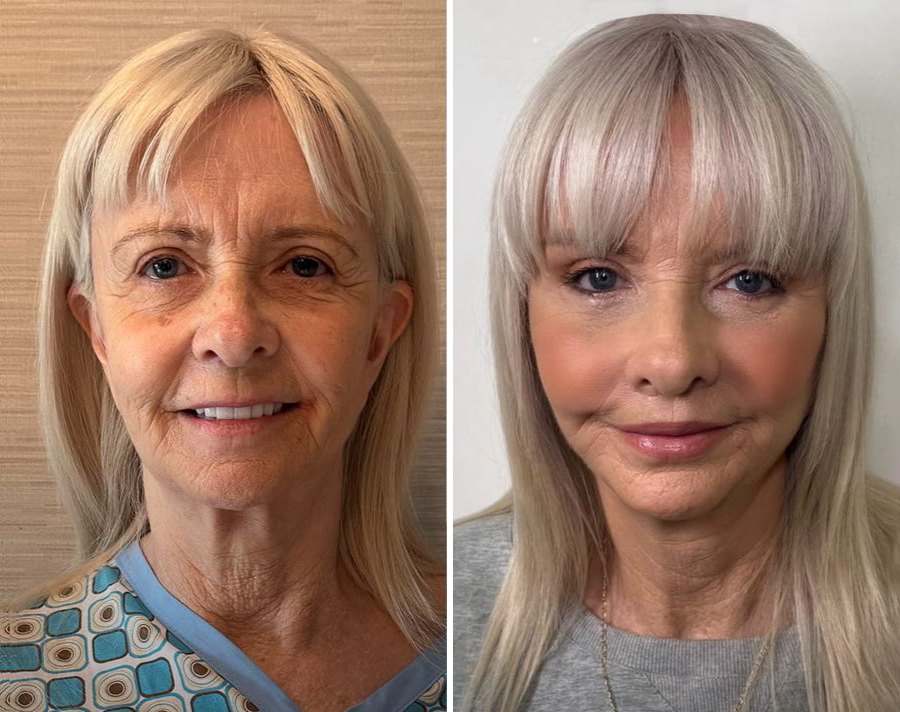
You can see more results on our homepage.
If you would like to put these questions to Op. Dr. Fevzi Kunter Erten, you can book a free consultation and talk to him by video before you decide.